Wednesday, June 26, 2013

Unrest

When I first told my parents that I was applying to the Peace Corps, one of them responded, "Okay, as long as you don't go to Africa." Most of the headlines that hit the papers in the US are about violence, conflict - armed or political, unrest, poverty, famine, etc. I assured them that Peace Corps didn't place Volunteers in countries in danger of conflict. When I was placed in Mozambique, I studied the history and current state. Although Mozambique has passed through two brutal wars to reach its current state of peace, stability and accelerating development, there has been little to no unrest since the peace accord was signed more than twenty years ago. In fact, Mozambique was ranked the 48th most peaceful country in the world on the Global Peace Index last year, compared to the US at 88th.

When I arrived here, I found a country full of people who want nothing less than they want another war. Here in Chimoio, economic development is really starting to take hold and I spend my time with Mozambicans who are working their butts off to take advantage of the opportunities afforded by a growing economy, improving educational system, increasing participation in the global economy and all the other things that come with peace and investment. There is still a looooong way to go for Mozambique to improve the lot of the general population, but it's starting to happen.

One unusual aspect of post-war political life in Mozambique is that both parties involved in the conflict - FRELIMO, the party behind Mozambique's independence from Portugal and RENAMO, the rebel force backed by colonial Rhodesia and South Africa - continued to be the main political parties ruling the country. FRELIMO has been in power since independence and RENAMO has continued to be the main opposition. Occasionally, aging RENAMO leadership has made threats to shake things up when it begins to feel irrelevant, but the general state of affairs has remained stable. International aid money has been pouring into the country and more recently, international investment dollars after the discovery of vast deposits of coal and natural gas.

Then suddenly, due to a convergence of factors, RENAMO's leader Alfonso Dhlakama started ramping up the rhetoric. He moved his troops to an old encampment in Gorongosa, Sofala, the province directly east of my province of Manica. Back in April, there was a series of three incidents between RENAMO and the Mozambican authorities, including an attack cars traveling on the EN1, the main highway connecting the northern and southern regions of the country. With municipal elections looming in November, Peace Corps Volunteers have been a little anxious about where this all would go, but things appeared to settle down. RENAMO and FRELIMO began talks in the capital to resolve the opposition party's demands for increased participation in the government and cuts of the revenue coming in from mineral resources.

But starting last week, the situation began to destabilize. It started with an attack  on an armory outside Sofala's provincial capital, Beira, in which seven Mozambican soldiers were killed. The following Wednesday, RENAMO declared they would "paralyze" service on the train line used to transport coal for export from Tete to the port at Beira and make transit through the central part of the country "fragile." Since then, passenger transit on the rail line has been halted and coal transport significantly reduced. Cars traveling through Sofala on the EN1 have been escorted by police in "columns," but there still have been a number of attacks on the highway. It is still unclear whether RENAMO has been behind all the attacks, if they have been by opportunistic bandits, or if they have been by RENAMO-affiliated bandits but not at the direction of party leadership. RENAMO has not taken credit for any of the incidents and disavowed involvement in some.

All in all, especially as an outsider, it is very difficult to know the seriousness of the situation. Mozambique does not have a robust domestic media infrastructure and fofoca flies unchecked through rural communities. On Monday, Peace Corps decided to consolidate PCVs in Sofala and parts of Manica here in Chimoio as a precaution. When they arrived, they described people in their communities as terrified for another civil war and reporting all sorts of different things without  a clear source: armed bands of RENAMO fighters marching towards Dombe one day and Tete city the next; tobacco farmers being attacked for their money and weapons; raids on arms stashes that never make the news. What we do know is that there have been a handful of confirmed attacks on cars traveling on the EN1, including a police-escorted column of traffic on Monday, and that people are scared.

Yesterday was Independence Day and we were all nervous that someone would see it as an opportunity to make a statement, but I have not yet heard of any major incidents. There have been a number of "peace marches" throughout the country by a population that may have problems with current leadership, but knows that armed conflict is not the way to resolve them.

Our Director of Safety and Security is scheduled to arrive here in Chimoio today to begin a "ground assessment" of the situation in the central region, then make a decision about whether or not the consolidated PCVs can return to their sites. I feel perfectly safe here in Chimoio, but my stomach turns at the thought that we might be pulled out of the country if the situation remains unstable; the idea of leaving the people I am just beginning to get to know because my government thinks that the situation is dangerous. How would I look my students and colleagues in the eye and tell them that I hope everything turns out alright for them, but I'm going to wait it out somewhere a little safer? Thinking of how hard they have worked to become university students and professors, their hopes and dreams for their futures, it just makes me angry to think that there are people who want to destroy that. But hopefully, everything will calm down and Mozambique will continue its peaceful march towards increased prosperity.

However this turns out, I have already gained a profound appreciation for the stability we all enjoy in the US. Even when a bomb goes off or a crazy person opens fire in a school or our government hurdles towards default on our debt, we don't have to fear that everything will suddenly collapse. As my friend and fellow PCV noted yesterday, what we have experienced here on a small scale over the last week is how thousands of people live everyday: with constant insecurity and fear of violence. I find myself hesitating to fully commit my time to lesson-planning for August when it's possible that I might not in fact be teaching Marketing here. What if the plans I wanted to make involved building a home, investing in my children's education or starting a business? It is clear why political stability is crucial for economic development, but it is different to have a taste of it firsthand.

CNN just ran a good article on what is happening now, but while the title is "Is Mozambique sliding back toward conflict?" I do want to call attention to the crucial statement:
Southern Africa is not what it was in 1992 when the civil war ended, and despite continued deep inequality and poverty, Mozambique has also changed. Renamo has demonstrated that it can pull off sporadic attacks with small numbers of armed men, but it lacks the resources or support to return the country to civil war.
During the civil war, there were large flows of cash and weapons coming in from neighboring countries, which are don't exist now. Similarly, the overall feeling from the population seems to be that they just want the violence to stop. The civil war came quickly on the heels of the luta armada, as the war for independence is known, but Mozambicans have now become accustomed to peace and they like it. My personal feeling is that Mozambique will not return to an all-out war, but my fear is that the environment will become unstable enough to deter further investment and will hinder continued growth. So I am hoping that cooler heads will prevail and Mozambique will continue to build on the progress it has made over the last twenty years of peace and security.

UPDATE (Thursday, June 27):  We met with Alfredo, the PC Moz Chief of Safety and Security, yesterday. He is leaving today to visit the sites of the PCVs who were consolidated for a "ground assessment." He has already met with the Chief of Police in Inchope, the town where the EN1 meets the EN6, the east-west highway connecting Beira to the border with Zimbabwe. They agreed that as long as vehicles require military escorts to pass through Sofala, it is better to keep PCVs away from their sites. The concern is less with their immediate safety within their communities, and more with the possibility of those communities being cut off by disruption of transit infrastructure.

Alfredo was very open with us. He made it clear that he also wasn't sure where all of this would go. His concern seemed to be limited mostly to the province of Sofala and he did not seem too worried that the unrest would spread beyond that region; however, he did mention that those who lived through the civil war know that this is how it started. This actually made me feel better, to know he is applying lessons learned from the past. Maybe I am being a blind optimist, but it just doesn't feel like Mozambique is poised to tumble into a country-wide conflict right now. Where I am at least, there just isn't a will for it and as I mentioned before, the critical factors such as outside funding aren't here this time. Although FRELIMO and RENAMO continue to have an antagonistic relationship, the up-and-coming third party gaining popularity in the central region is one that urges compromise. There is economic growth and increased foreign investment and people feel like they have something to lose if there is disruption. I am sure the feeling is different in areas outside a city like Chimoio, where the wealth and economic opportunity may not have arrived yet, but I will remain optimistic for now.

Tuesday, June 11, 2013

Uma Grande Confusão: Life Ouside my Culture Takes its Toll

When I arrived here, I was immersed in a new culture that functioned in multiple languages I didn't speak or understand. Even as I became more comfortable with Portuguese, a big part of life for Mozambicans in Namaacha was lived in Changana and remained a mystery to me. Most of my host mother's conversations with Isaura, the woman who worked in her house, or her friends that came by, were in this local dialeto and were completely incomprehensible. Even when they were punctuated by pauses during which they all turned and looked meaningfully in my direction. I would have loved to have learned some Changana, but just learning Portuguese - the language I would need to teach my classes - was challenging enough. Sometimes, when I would try to learn a few words of Changana, it felt like my brain was putting its foot down and actively rejecting this other language. "Can't you see I'm already overwhelmed here!" it would ask.

The idea of teaching in Portuguese terrified me!
And the truth is, it was overwhelmed by all the newness I was asking it to absorb, and not just the new language(s). When I had been living within my own culture, I had had an understanding of what was going on around me at a pretty profound level, something that was easy to take for granted while I remained there. Then, finding myself in the midst of a new culture, I realized that all those layers of understanding that reach down past the superficial were suddenly missing. Even when I did understand the words being spoken, I often didn't understand the why behind the situation. In the US I knew the culture, customs and norms. I knew the way things usually should go in most situations and could easily perceive when something was off. The greater cultural context was familiar, letting me piece things together when I didn't have all the background information in order to make sense of what was going on. All this was gone when I arrived in Mozambique. 

Taking all this familiarity away leaves you feeling pretty lost sometimes. To get by as I was learning the culture, I quickly got used to operating in a state of incomplete information, mild confusion and disorientation. I developed the habit of just shrugging things off if I didn't understand, knowing that either someone would explain it eventually, or understanding it fully wasn't really necessary. For example, I usually just go to the ATM when I need money, but a few months ago I had to go speak to a teller inside for the first time. I entered the bank and the guard directed me to the end of the 30+ person line. There were about five tellers with open windows, and as one person wrapped up their transaction, the next person in line would walk up and stand directly behind them until they could speak with the teller. Then, all of a sudden, a man walked in the door of the bank, paused to survey the line and proceeded to duck under the rope and stand behind the person at the second window until she had finished her transaction, at which point he took her place and made a withdrawal from the teller.

As I watched, I kept expecting the people waiting in line to get upset and tell the guy to wait his turn, but there was no reaction. My head kept jerking back and forth from the man to the line in disbelief of what appeared to be a simple case of a guy not wanting to wait his turn and a crowd of 30 people simply not caring that he cut them all. I kept wondering if I could do the same thing, or was this guy some sort of local celebrity or power-player? Was there a certain kind of transaction that let you sidestep the line? My indignation quickly faded to confusion, which was replaced by resignation to the fact that I was in yet another situation where I just didn't have the context and information to understand what was going on. And in the end, it didn't really matter. I would wait my turn, get my money and head back to school. Even if I knew why this guy had been able to walk straight to the teller without anyone even blinking, next time I needed money, I would still stand in line.

When I first arrived in Chimoio, everything was a mystery. I didn't know where to find anything in the huge market and had no idea who was there to help and who wanted to rip me off. I didn't eve know what some of the fruits and vegetables were. The bustling crowds of people in the center of town were overwhelming. I didn't know prices or quality or what people were yelling at me. My Portuguese has improved vastly in the past six months. I've made friends at the market and look forward to going there. At school, I am still learning the system and still spend a lot of time just waiting for someone to explain to me what is going on, but I usually feel comfortable. I finished a semester of teaching in Portuguese with very positive feedback from my students. I am starting to make some friends and generally feel much more at home here.

The market intimidated me when I arrived, but I went to church with this guy this morning!
That isn't to say that I have stopped feeling like I don't really know what is going on. Although I have learned lot since I arrived, both about language and about customs, I still miss most of the significance beyond the surface. This past Sunday, I went to church with a friend where much of the mass was in Chiute, the local dialeto here in Chimoio, which I have still not begun to learn. The sermons were translated to Portuguese, but much of the talk that would have explained the different parts of the mass were in dialeto. I was completely lost as to when to sit, when to stand, when to get up and introduce myself, when to throw a few meticais into the basket. But this didn't bother me. I just waited for a poke in the ribs to stand, figured it is never bad to give a little money, clapped my hands and enjoyed myself. It was just one more time where I was able to participate in an experience outside my own culture, which involves a bit of confusion, but leaves me feeling like I have grown some.

Last night, my power cut out just as I added a bunch of chopped tomatoes to a pan full of onions and garlic. I groaned, realizing that time had been passing so quickly lately that it had been almost a month since I last bought electricity. Here, I have to pre-pay for my power, bringing cash and the code on my meter to the Electricidade de Moçambique office down the street. They put credit on my account and print out a receipt with a code I type into the meter when I get home. It was only about 6:30 when my credit acabou, so I decided to see if the office was still open.

I arrived to find a line reaching past the end of the building. The door to the office was closed, there were only about three people inside and a couple of people were talking to the guard at the door, but everyone in line was sitting quietly, waiting. The people at the door turned and walked away, leaving the premises without having entered the building. I was confused, but there were only two questions that really mattered, and asked the guy at the end of the line "Ainda está aberto?" When he answered, "Sim," I followed up with, "Até que horas?" To which he responded, "21:00." Good. It was still open for another 2+ hours, so I wouldn't stand in line for an hour, only to have the door shut in my face as the office closed for the night. Beyond that, the way the line was being controlled didn't really matter. I would be able to cook dinner. I sat, thinking about this blog post, actually, and was presented with yet another illustrative example.

I'm getting used to livestock as a part of everyday life: even graduation ceremonies.
After about forty minutes, I was the fifth person in the outside line, close enough to the door to witness the following situation. Two young men who were probably Lebanese walked past the line and approached the guard at the door. One began to speak with him, but I was just far enough away and his Portuguese was just accented enough that I couldn't quite make out what they were saying. I could make out the word cão and was getting pretty confused as to why he would be talking to the guard at EDM about a dog. I assumed I had misheard. Then he turned, lifted the back of his tunic (thobe?) and rolled up the bottom part of the pant leg underneath to show the guard his calf where there were the marks of what appeared to be a recent dog bite. Now I was really confused. Had he been bitten on the EDM property while standing in line? The guard was shaking his head and talking, but no matter how much I strained to make out the words, I couldn't quite hear. The guy nodded, rolled down his pant leg and after a couple more exchanges, they men turned around and walked back to the motorbike parked in the EDM lot.

As they rode off, I tried to make sense of the interaction. The provincial hospital is across the street, so maybe they had been confused and thought that the EDM building was a clinic? The line outside did look like the line you often encounter outside clinics around here. But, both the EDM building and the hospital are pretty clearly marked. The guy spoke Portuguese but maybe he didn't read it? No one in the line looked very sick and almost every clinic line is full of mothers holding babies, which this one wasn't. But why else would someone walk up to an EDM office and show a dog bite to a guard at 7:30 at night? Once again, I accepted the confusion and shrugged it off. I still really have no idea what the who interaction was about.

So, why was I thinking about writing a blog post about how comfortable I have become being confused by what is going on around me? I recently had an experience that made me realize it has gone too far. It had nothing to do with Portuguese or Chiute or Mozambique. It happened when I watched the fourth episode of the second season of The Wire.

I have had dozens of people tell me how great the show is, so before I left for Moz, I made sure I had all five seasons. I haven't had as much time to watch it as I expected, but I'm making my way through. I loved the first season, but finished it a little confused as to why there was one episode that didn't seem to belong with the rest. At the end of the third episode, one of the characters had been taken in for questioning and then all of a sudden in the fourth episode, he was looking at making deals to get time knocked off his sentence. One of the characters, a usually plain-clothed detective, was suddenly back in uniform. I thought it was strange, and even double-checked that I was indeed watching episode four. Since I was, I shrugged it off, assuming that I had missed something of significance regarding the arrest and the uniform change. They introduced two new subplots that never went anywhere. The Wire is really tightly written, but sometimes I have watched shows that start down one path only to change directions. "I guess I just missed some details," I thought to myself, continuing along to finish the season.

The second season opened with a plot featuring the characters of one of the "abandoned" subplots. "How strange," I shrugged once again, "that they would make a whole isolated episode in the first season and only come back to it eight or nine episodes later. But who am I to judge how they choose to structure their show? I'm just along for the ride." Slowly but surely as the episodes progressed, it became clear that the action was happening prior to the episode I had already seen, and what had happened began to dawn on me. I had watched an entire episode of the second season completely out of order and simply shrugged off all the plot inconsistencies. I was so comfortable with things not always making sense that my brain did not balk at the fact that all the detectives were reassigned to a new detail that once again did not exist in the fifth episode. I simply accepted the fact that two main characters were suddenly in prison, having been sentenced without comment by the show.

Watching again in the right order, I couldn't believe that I hadn't seen what was going on the first time. I realized that my comfort with confusion has reached a dangerous level. Getting by here without going crazy requires that I turn down the voice in my head that is always demanding to know why people are doing what they are doing, why things are happening the way they are. But this can go too far. I think it is time to start reengaging some more!


Friday, June 7, 2013

Wisdom that Knows No Borders

I noticed recently I seem to be making lots of statements along the lines of, “My father once said to me…” or “My mother’s advice was always…” Basically, my parents are really smart, and I find myself passing their wisdom all the time. Although neither has ever been to Africa, let alone Mozambique, their insight knows no borders and is just as applicable here as it was in the US.

When I was in college and started studying math, I remember having long conversations with my father (at the time a second-grade teacher) about when and how things start to go wrong for kids who grow up to feel like they “just can’t do math.” I had started tutoring and ended up with a lot of students who were studying to pass the basic math requirement test. They would come in, months away from graduating, most very intelligent and confident when it came to English or History or Anthropology or whatever they were studying, but one look at one math problem and they would freeze up, staring helplessly at their tutor, hoping she held some magic key that would unlock the secret of finding the lowest common denominator, would make this hopelessly opaque concept suddenly clear. 

Of course, this isn’t how math works. Despite a pretty common idea that some people are “math people” and some people just aren’t, learning math is a process like any other subject: you have to learn the basic vocabulary, the basic rules, and then get comfortable with manipulating statements within this framework. Only in math, the statements are equations instead of sentences. My father is a “language person” more than a “math person,” but he always put an equal effort into teaching his kids the fundamentals of both areas. 

I remember coming to the conclusion after a few months of tutoring that fractions are where things first go wrong. The college-aged, fear-wracked students that I was encountering almost always froze up on fractions, something that they learned (or didn’t) during the time folks like my dad were in charge of their education. When I proposed this to my dad, it led to a fascinating conversation about the fear that some of his colleagues had of fractions and how this could be transmitted to their students. Beyond that, we started talking about what schools would do to address these problems, which in his experience often included training on the latest, greatest, best method for teaching math. They would bring in an expert who had developed a method, much better than previous methods, with plenty of studies showing this through improved test scores, etc. But of course, when it was implemented by other teachers, the results were never equivalent to those achieved by the one who had developed it and in a few years it was replaced by the newest-latest-greatest.

My father’s wise take on this was that the problem didn’t usually lie in any kind of fraud by the author of the new system, it probably had resulted in a huge improvement in the students learning directly from the person who had developed it. The problem was usually a lack of alignment between this process presented as a panacea that would make anyone a significantly better math teacher, and the specific skills of the teacher implementing it. Every teacher has strengths and weaknesses and making them use a system that does not play to their strengths will rarely lead to success.
This is something that has stayed with me through the adventure of becoming a teacher here in Mozambique. We went through ten weeks of training when we arrived that included numerous presentations by trainers, current volunteers and fellow trainees. There was a lot of discussion of the best ways to handle different subjects and different situations: the need to be a disciplinarian or the students won’t respect you; ways to structure lessons; ways to mark homework or they won’t do any of it. This definitely planted seeds that can spring up as self-doubt after a bad day. But I always come back to those conversations with my dad: every teacher has their strengths and I will have the best outcome if I emphasize those instead of trying to be someone I am not. I always try to be honest with myself about what I do well and what I don’t.

For example: I am NOT a disciplinarian. If I tried to be, the students would be able to see right through it and it would only harm my credibility. Sometimes I wish I could march into the classroom and make everyone snap to attention, but this just isn’t my style. Now, since I generally maintain a relaxed environment in the classroom, when I do snap at someone, it works. My strengths are more along the lines of keeping people engaged through participation and keeping them on my side with self-deprecating jokes about my Portuguese. All of my students have been extremely supportive and helpful with language throughout the semester and I think that mainly comes from the fact that I have the self-confidence to be honest about my abilities and my, um, disabilities. When I realized the wealth of experience my evening students were bringing to my Management class, it was a little intimidating. But I overcame this by focusing on my strength in facilitating conversations over my weakness stemming from my lack of experience in the Mozambican context. I frequently let the students become the teachers, sharing their relevant experience with the rest of the class. They ended up learning the concepts better than my day students (as measured by test scores) and I probably learned as much as they did over the course of the semester. 

And it all comes back to my wise father’s observation: when teachers are able to play to their strengths instead of being forced into using a method that isn’t natural for them, they will be better at their jobs. The same habits that make a teacher happier and more confident are the ones that make them more effective, so when I am true to myself, I am more likely to succeed.


My parents’ wisdom extends beyond the classroom, as well. My mother, more than anyone else I have ever met, can read people. Within moments of meeting someone, she has picked up on subtle nuances of their presentation and manner of interacting with people that give her more insight than most people can glean in years of contact with that person. Unfortunately, this is a skill that can’t be passed on in the form of advice. She once, however, gave me some advice about how to read interactions with people that I have found to be useful in every stage of my life. I don’t remember the context, but I can imagine it was a time that someone had said something that upset me, but I didn’t know why. She advised that, often times, the words a person uses are less important than how they make you feel. [Edit: While I originally attributed this advice to my dad, I believe it actually came from my mother. They are both so wise, sometime it is difficult to remember the origin of each individual counsel!]

This came up recently in a conversation with a PCV friend who was having problems with her school director. She and her roommate were the first volunteers to work at the school and the relationship got off to a rocky start. The director lived next to them and was a heavy drinker who would get overly friendly when coming home from the bar. He would call repeatedly and then start knocking on their windows well after they had gone to sleep. One night he started shining a light into her bedroom as she was sleeping. They had seen female students visiting him at his house and, in a country where trading grades for money or sex is not uncommon, it seemed clear that this guy was not above taking advantage of his position.

My friend had pushed back against his behavior and had eventually resorted to speaking with our Peace Corps program director, who spoke with the school director. This only worsened things between my friend and her director. He started making new rules weekly, mainly to limit when she was allowed to leave her site. The town is very small and isolated, requiring hours of travel to get to the nearest larger town or to another site to see a Peace Corps friend and now the director was making rules preventing her from taking the time she needed to resupply or just take a break from life at site. But these limits only had the effect of making her want to leave more. As we were sitting at my table, drinking tea and discussing this increasingly antagonistic situation, my mom’s advice came back to me. Even though she didn’t want to leave her site every weekend, the fact that she couldn’t was making her crazy. Why were his rules having this effect on her? It seemed to be that the conflict wasn’t really over her ability to travel, but over his need to show her that he was in control. She wanted to go visit her friend? Too bad. He was in charge and she had to stay. Accustomed to using his position to start sexual relationships, when she had said very clearly “No,” he found another way to show her he was boss: restricting her mobility in and out of site. In America or Mozambique, looking beyond someone’s words and scrutinizing their effect on you can provide insight into the dynamics behind the interaction. 

I could fill a book with the good advice my parents have given me and may come back to it in another post, but for now, in this time between Mother’s Day and Father’s Day, I will simply say “Thank you!” My parents have given me so many tools to find my way through complex situations at home and abroad, in my personal life and professional life. I am truly a lucky girl.

Monday, May 27, 2013

Road Trip! Machanga for a challenging workshop, sweetened by dancing with kiddos.

It has been a little while since I have updated, mostly because as the semester comes to a close, I have been busier than ever. As a teacher, I have been wrapping up classes; grading assignments; and writing, proctoring and grading tests. As a departmental coordinator, test time means making sure all the other teachers submit their tests when they should, then pick them up to grade them; this coming week it will mean collecting and verifying all the pautas (grade charts) that will determine which students are eligible to sit for their final exams next week. We have also started planning classes and professors for next semester (which starts in August) and my university has decided to make a push for more research which will launch with our first annual research symposium for two days this week. The focus on research also means a third hour-plus-long meeting for coordinators each week. I am starting to look at making some changes to my coordinating responsibilities for next semester to leave me more time for my teaching while still being involved in things like English Club – which has the potential to be of real value to the students involved, the REDES income-generation project I am about to write more about, and good old-fashioned getting to know my community. 
My turma diurna during our last English class
When I have had some free time, I have been slowly building up a little garden of herbs, peas and soy beans – some things that I can’t find in the market here. I have added a couple more items to my capulana dress collection and have found that the modistas here in Chimoio make some high-quality clothing. Chique capulana clothes have the added benefit of being great conversation starters. And since I was diagnosed with anemia last month, I have been spending more time cooking real food.
But the highlight of my recent activities came this past weekend when I traveled south for the first test-run of the palestra/mini-class on entrepreneurship that I have been helping my friend and fellow volunteer develop. While we had mixed results for the palestra itself, the visit overall was just what I needed. Since school has kept me so busy this semester, I haven’t had much opportunity to visit other volunteers’ sites. I adore Chimoio and my students and colleagues here, but the experience I have here is very atypical for a Peace Corps Volunteer and the people I spend most of my time with live lives different from your average Mozambican. If I left Mozambique now, I really wouldn’t be able to speak to how 95% of the country lives.
So, I was really excited to have the chance to spend a few days at a more rural site, particularly because my friend thre who is halfway through his second year has really put an effort into connecting with a broad swath of people in his community. Over the course of three days, I was able to experience many of the things that so far have been hard to come by in Chimoio: sitting and eating with a family at their home, meeting the doctors in a local hospital, partying with crianças, watching a traditional medicine man’s dance and, since I forgot my running shoes, I even got in a barefoot run by moonlight. Add to that some quality time with my awesome hosts (including some impromptu yoga with the two tallest men in PC Mozambique) and a surprise visit by one of my favorite girls from my training group, and it easily would have been worth twice as long in a chapa as the 9 hours it took each way. AND I got some wonderful pictures to share here!

Maybe my favorite. She insisted on having her picture taken, but this is the only face she would give me!
My friends Mac and Jesse live in Machanga, a small town about an hour and a half down a dirt road from the N1, the main north-south highway in Mozambique. There is one chapa that runs from Beira to Machanga and if you don’t get on this, the only way in and out without a private vehicle is by taking a canoe-ferry across the river south to Nova Mambone in neighboring Inhambane province and to travel from there back to the N1. Luckily, I was able to get the chapa both ways. Some would say that it is actually better to travel through Inhambane and hitch a ride in a private vehicle – this can be faster (without dozens of stops to pick up and drop off cargo and money that the chapa transports along with the passengers) and is usually more comfortable (one person per seat, fewer chickens nestled up against your hip and I had for seven hours this morning), but traveling by myself, I preferred getting the chapa to hitching. Plus, it’s an experience I don’t get too often and I usually end up with at least a few pictures of adorable children.
My chapa buddies on the trip to Machanga.
Machanga is a small town on the Rio Save, full of dirt roads cutting through fields of sorghum. There is a small center with and handful of shops selling a small variety of industrial food and home products, along with a moderately-stocked market featuring little more than the staples of tomatoes, couve, dried fish, onions and garlic. Some of the buildings still show signs of damage from the civil war that ended twenty years ago. The people are friendly and nearly everyone knows the two absurdly tall muzungus who teach at the secondary school. Mac and Jesse live on school property, along with many of the other teachers. The houses are concrete and small, each with a porch opening onto a shared yard area. They have electricity, an easily accessible well and an attached bathroom with a pit-toilet. Other than the neighbor playing Lil’ Wayne and Elton John on alternating repeat and the constant sound of children playing in the yard, Machanga is blessedly quiet. 
Palms and sorghum stalks by day; sunset in Machanga; moonlit clouds by night.
Mac has taken to eating most nights of the week with a family that lives in a power- and water-less hut about a twenty-minute walk from his house out into the bush surrounding the town. One day while walking by the hut around lunchtime, Joana, one of the women living there servido’ed Mac and his visiting friend (Mozambicans have a very hospitable habit of offering whatever they are eating by proffering the plate or pan and telling you “servido” or “you are served”) and they accepted and asked if they could come back for dinner. Since then, he has started bringing a load of basic groceries each week, then joining them for dinner four or five times. 
Joana and her family.
We ate with them the first and last nights of my visit and it was really nice sitting around the open fire over which they cook and just chatting and laughing with them. Only a few in the family speak any Portuguese, but Mac has developed a handful of running jokes with them using the fifty-or-so Ndow words he knows. The first night, we lucked into a plate of xima served with two carrils, one of little shrimp and the other of small river fish. The second night, since our friend Karina was visiting and we were three mouths, we brought a few packages of pasta, some potatoes and carrots. It was lucky we did, because the men of the family had not returned from town that night and the women, left without money or food, were about to go to bed with nothing to eat. We cooked up the pasta with salt and ate it with our hands from a shared plate. 

Friday morning, I joined Mac at the community hospital, where he recently started to volunteer when they have work for him. They didn’t have anything for us to do that morning, but one of the médicos gave me a tour of the facilities and we talked with a few patients there. The majority of patients we saw there were pregnant women, young mothers with thin, sad-eyed children and HIV patients. Everything was impeccably clean. The pharmacy was well-stocked, the equipment looked well maintained and there was even a TV mounted in the outdoor waiting area. The doctors, nurses and lab techs I met all seemed energetic and engaged. Despite the conditions of the patients there, I left encouraged by the apparent quality of care at this facility, after some stories I have heard about care provided to those without financial resources in Mozambique.
A worried mother whose daughter has worms; Dr. Mac practices taking pressure; a young patient.

We spent the rest of Friday relaxing and finishing plans for Saturday morning’s mini-workshop, the impetus for this trip. Mac has been developing the beginnings of a program on entrepreneurship to use with his REDES group. REDES (Raparigas en Desenvolvimento, Educação e Saúde) is a network of groups of secondary school girls dedicated to education about HIV/AIDS prevention, avoidance of unplanned pregnancies and general empowerment of women and girls in Mozambique. The project is PEPFAR funded and implemented by PCVs who work with Mozambican counterparts to build a group that can eventually be run by the Mozambican leader, but still with the support of PEPFAR funds and the network of other groups.
Mac had wanted to start a project aimed at generating income that could be used to pay school fees for girls in his community who couldn’t afford them. Since entrepreneurship and women’s issues are two of my favorite subjects, I volunteered to help Mac develop the materials. Then, PEPFAR funding was slashed and the REDES leaders saw the project as a great way to begin funding some of the activities that PEPFAR would no longer support. Teaching women business skills and providing them with the means to have independent income is also one of the best ways to achieve all the goals of the REDES program. Now half of the annual, two-day, country-wide workshop will consist of the program we develop. It has been fun to work on, but challenging to try to write a booklet that can be used by facilitators throughout the country, with backgrounds and abilities that will vary enormously and with audiences of girls with little to no knowledge of how a business runs. So, this Saturday was the first test of the material we have developed so far, and we came out with mixed, but very useful results.
Mac is in the process of asking his student leaders to take greater leadership roles, but the transition has not always been going smoothly. We encountered some glitches due to poor/non-existent communication between the leaders and the rest of the group that set a rather difficult tone to start the morning on Saturday. This was compounded by even bigger problems with the other group who hosted us for the test run. In the end, since this was a test for a program that will be used by people in many different circumstances, maybe it is better that we were in less-than-ideal conditions.
After our challenging morning with the REDES girls, which left us feeling a bit drained and frustrated, we stumbled across the perfect antidote: a joint 2 year-old/6 year-old birthday party, complete with food, dancing, cakes, party hats and loads of adorable children who just wanted to be picked up and swung around. It’s amazing what a couple of hours of grinning, laughing, dancing children can do for the psyche.


We left feeling reinvigorated, just in time for the arrival of a walking ray of sunshine in the form of our friends Karina. After a quick, sugar-infused visit/photoshoot with Mac’s 11 year-old neighbor and friends, we headed to dinner at Joana’s.
Karina, João and friend. So much sugar in those cups, might as well have been tequila.
On our way home from dinner, we heard drums in the distance. We had heard the same drums the night before, but had decided not to investigate because we needed our beauty sleep for Saturday morning’s workshop. Mac thought the drumming was coming from the house of some of Machanga’s curandeiros, or traditional medicine men. The night was brightly lit by the full moon and as we made our way through the fields of towering sorghum, with the sounds of drums and chanting growing louder with each step, I suddenly felt a little like I had stepped out of my own life and into a story about the Peace Corps. 
Women singing and playing instruments, others dancing.

We finally arrived at the curandeiros’ hut and were greeted by the bare backside of a sweating man straddling a set of three large drums. He was flanked by a few other drummers seated on esteiras (reed mats) and a woman seated among them, legs extended and whole body trembling. Based on his experience with other ceremonies, Mac conjectured that she was sick and having bad spirits expelled. We stayed another twenty minutes of so, watching as groups of women wrapped in capulanas and wearing white headbands danced in circles, at times holding up small axes and other tools (weapons?). Karina and Mac both joined in for a dance, but I decided I had more to contribute as the photographer. Because of the full moon, I was able to get some blurry but intriguing shots with a slower shutter speed.
The experience was fascinating and the music was wonderful, but I sure would have loved to have had someone there to explain what was going on. But sometimes I feel the same way in staff meetings at school… Such is cultural exchange. 
I got on the chapa at 3:30 the next morning, ready to head back to Chimoio and my daily life of meetings, internet problems, plentiful produce and paved roads. It was great to experience a little but of what some of my friends are doing with their communities, but it also motivated me to want to get to know my own better.

Sunday, May 5, 2013

My Work and the People Who Make It Awesome

You wouldn’t know it from my blog, but I spend the vast majority of my time here at school. I haven’t written much about my work here, but it isn’t because my job isn’t interesting. My first semester is coming to a close and, other than some long meetings that stretch into lunchtime, not a moment has been boring. Challenging, yes, at times nearly overwhelming. But also fun, and frequently inspiring. This is mostly because of my colleagues, and of course because of my students. 
Come of my colegas and director at Dia da Mulher Moçambicana
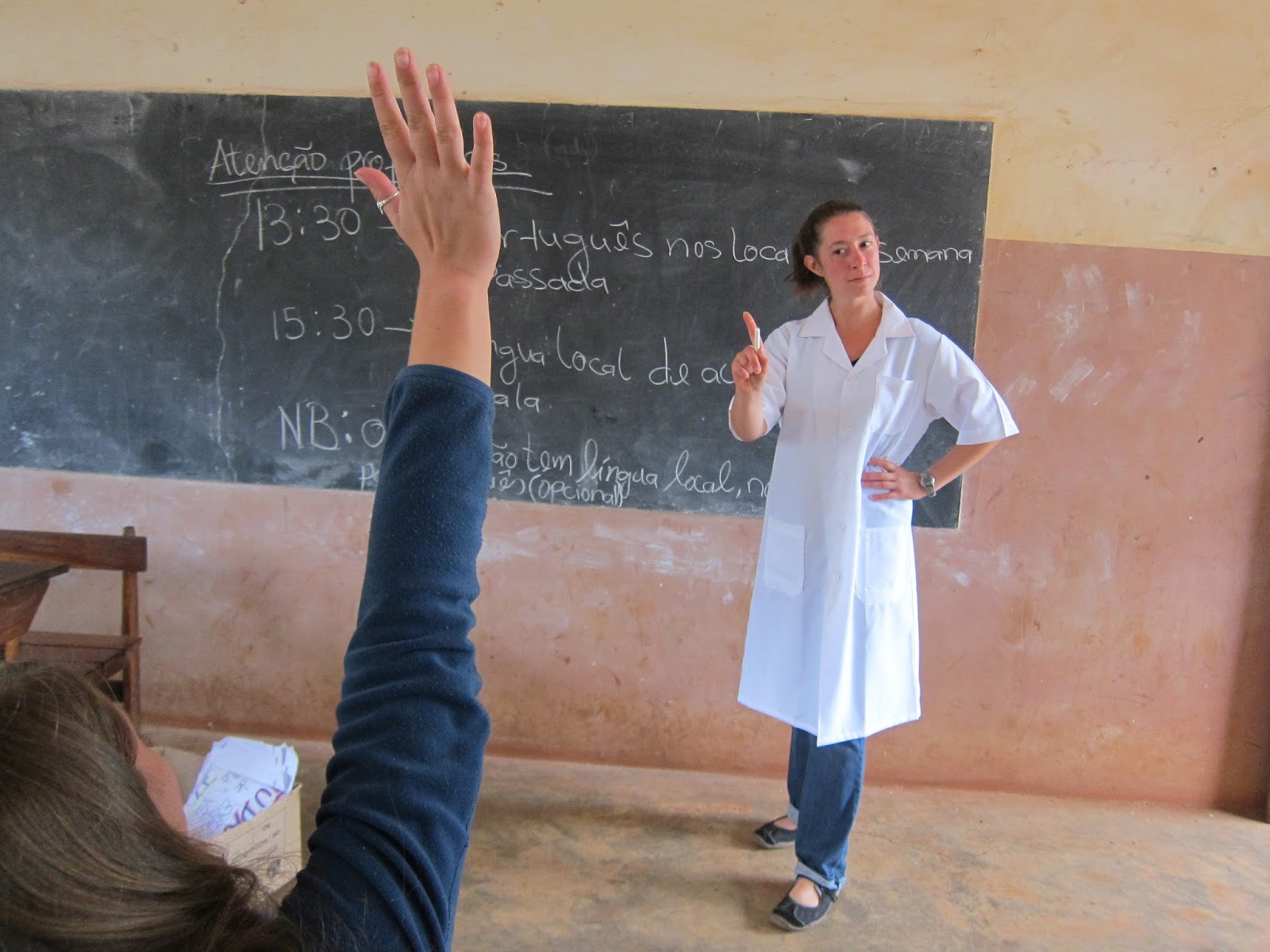
First, my colleagues. Actually, first the recap for those of you not taking notes. I am working at the Catholic University of Mozambique, one of three PCVs there. I have been acting as the coordinator of the Communications for Development program, which usually just means sitting through some extra meetings, making sure that the teachers are signing their timesheets and making various schedules for classes and exams. Occasionally it means getting up and making speeches in Portuguese about what our program is doing. Gulp. I have a right-hand man who graduated from the same program at one of the other campuses and is there to help me with all the issues related to course content and research. I have also been teaching an English class and Gestão de Empresas (Business Management) in Portuguese. Gulp, again. 
My right-hand man
Second, my colleagues. Actually, second, my university. The founding of Catholic University in Mozambique was one of the crucial factors that led to the signing of the peace accord twenty years ago, ending fifteen years of brutal civil war. At the time, the only university in the country was Universidade Eduardo Mondlane, located in Maputo, the capital city that was (and still is to a large extent) home to much of the country’s wealth. The opposition forces demanded as part of any peace agreement, a commitment to the creation of institutes of higher education in the northern and central regions, that would be available to the poorer populations, helping to address the massive inequality of wealth and opportunity. The Catholic Church, which held been assisting with the talks, took on the project. I personally think that equal access to higher ed is a pretty awesome demand at a peace negotiation.
My campus in Chimoio, the Faculdade de Engenharia, was founded in 2005. The flagship program is Engenharia Alimentar, or food engineering, which mostly deals with food processing and preservation. We now offer eleven undergraduate degrees and three masters programs, including an MBA taught mostly in English. UCM also runs a distance-learning program, which has a center at my campus. Distance learning here does not mean online classes. No, these are basically correspondence courses run with a packet of workbooks delivered by truck to each student once a year. Many of the distance courses are aimed at training teachers in specific disciplines. 
UCM Chimoio
Now, my colleagues. My director is an agronomist, educated at West Texas A&M, he returned to Mozambique and has led agricultural extension projects, directed a small business incubator, founded the food engineering program at UCM and continues to raise pigs. A music lover, he keeps his guitar in his office and serenades us at most school celebrations. He has a consistently positive attitude and seems genuinely invested in the development of his students, teachers and country. He is not the only person at the school who was educated abroad and returned to Mozambique to contribute to its development. A fellow English teacher was born here, but raised in Zimbabwe and educated in the UK. As he said, he left a very good position in Zimbabwe and despite the fact that he could have worked in Europe or the US, he returned to Mozambique because his country needs trained professionals. His dream is to open a high-quality boarding school near Chimoio that offers an education in English that would qualify graduates to go to college anywhere in the world. Another professor in the Food Engineering department left a position in the US to build the program here. He is also driving an effort to improve research efforts at the university.
Take 1, 2, 3 at Dia Internacional dos Trabalhadores (Worker's Day)
Many of my colleagues are on the younger side. Mozambique’s education system has begun to make great improvements, but during the war years, there were not very many college graduates, limiting the pool of candidates above a certain age. Many of these young professors are working long hours teaching their classes, taking on all sorts of extra projects to improve the quality of the programs offered, all while starting families and frequently pursuing graduate degrees at the same time. It definitely makes me want to put my maximum effort into what I am doing here.
But the thing that really puts a spring in my step here is working with my students. I teach both English and Management to two turmas, or groups of students, one in the day program and the other at night. They couldn’t be more different, but I adore them both for very different reasons.
My fourteen daytime students are what you would expect in an American classroom – most are around 20 years old; many come from middle class families here in the city. The girls are chique de matar – well dressed, with their shoes matching their earrings, and the occasional French manicure. They are all in the Communications for Development program, but with a variety of career and life goals.
One of my favorite moments with this group came in our very first Management class. I prepared an information sheet for them to fill out. Coming in, I had never met a Mozambican university student and I had no idea what kind of work experience they were bringing in, or what they were hoping to do with their education. Management is the kind of broad subject that can be adjusted quite a bit to fit the audience, so I asked them to tell me what kind of work they had done (little to none for most of my day students) and what their professional goals were. A handful said they wanted to go on to get a masters degree, but many responded with, “I want to get a good job.” I had fifteen minutes to kill at the end of class, so I threw out the question, “What exactly is a good job?” Best question ever.
What followed was a twenty-minute debate, only slightly encouraged by me and mostly fomented among the students, on what is most important, to make money or to do work that you love. Having only heard stories from secondary-school teachers here about how frustrating it is to motivate students who don’t see the importance of education because they don’t see a future for themselves other than working a small farm and trying to get by, I was blown away by the conversation. After a lively discussion, the consensus seemed to be that the best situation is to find a job that pays enough to provide a comfortable life, but within a field that you find interesting and in a role that provides room for growth. I was just trying to imagine how the debate would have gone among a randomly selected sample of fourteen UMass students. I think it would have been a step or two less sophisticated.
My night students had very different answers to almost every question on the survey. One question was “Why did you choose to study Communications for Development?” For my day students, the answers mostly fell on the side of Communications: lots want to go into Public Relations or Marketing. My night students, on the other hand, focused more on the Development side. I only have seven students in my evening turma, many of who have been working in the journalism/communications/media production industry for years. Much of their work has been with community organizations and the majority of them stated that they wanted to use the information and skills they would learn in this program to help in the development of Mozambique, because the country needs trained professionals. So far, I have found that many people in the up-and-coming middle class here are acutely aware of what their country needs and are motivated to work for its betterment, at least in the university community. Even the younger students who dream of studying abroad: most have stated that they want to go to graduate school in another country and then come back and work to develop Mozambique. 
My student mic-ing a speaker at Dia da Mulher. I need to take more pictures of students!
The experience that my night students bring into the Management class has led to some fascinating discussions. When they filled out my background survey, most of them filled at least half a page with their work experience. One is a filmmaker; another works for Chimoio’s community television station and I see him at almost every city event, holding a microphone or camera in front of speakers and presenters. A third works for an organization that produces a variety of public-interest media. I had the opportunity a few weeks ago to record the English narration for a video they made on the economic potential of Manica Province. After I read their survey answers, I was relatively intimidated by the idea of being the one in the front of the classroom, trying to teach them anything, but I used that as motivation to make sure I was providing them with information that would actually be applicable to their work. I also try to encourage as much discussion as possible in our classes, so they can learn from each other as much as from me.
The best discussion so far came two weeks ago after two students presented their work on how to carry out a Community Needs Assessment. I had assigned group presentations on conducting environmental analyses as part of the strategic planning process. Since it is a business management class, I asked most groups to research traditional business-related analyses: Porter’s Five Forces, the BCG Matrix and the GE/McKinsey Portfolio Analysis. But since it is a development-related program and many people are or will be working with NGOs and community-based organizations, I asked one group in each class to look at a less competition-based model, namely the techniques used in a community needs assessment.
The group that presented during the day did a wonderful job and really drove home why a community needs assessment is so important for development projects. But because my evening students have worked on countless development projects, the half-hour-long presentation turned into a lively 90-minute discussion of their experiences with projects that failed because of a lack of community involvement in the planning process, which techniques work best and which can be misused. It was wonderful. I only wish I had a recording of all the stories: I swear it could be used to train people in managing community projects. I have to share one story that I am also going to have to pass on to the Peace Corps trainers to use when they are presenting the Community Needs Assessment; it is just to perfect and exemplifies why my students are the ones adding the real value to our course.
The point of a community needs assessment is that development projects often fail when someone comes into a community thinking that they already know what it needs better than the community members themselves. They do not take the time to understand the daily, weekly and yearly routines; the complex relationships between people and activities; the real needs and motivations of the people they are nominally trying to help. They see a problem and jump to a conclusion about the solutions, without the community’s input on their priorities. To illustrate this, my student told the story of a Mozambican community located on the banks of the Zambezi River:
This community had a lethal problem: every few months, a woman was getting eaten by a crocodile when she went to get water from the river. A development organization working in the area heard of the problem and immediately knew the solution. Clearly, the best way to prevent the deaths would be to eliminate the need for the women of the community to walk down to the river and haul back jugs of water. The organization dug a series of wells within the community and installed pumps, providing a secure source of water far from the danger of the river and significantly reducing the effort needed to procure water. Satisfied that they had addressed the problem, the organization went back to its other work.
A few months later, another woman fell victim to a crocodile as she fetched water from the river. Baffled, the organization returned to find out why the water pumps weren’t being used and women continued to expend unnecessary effort, hauling water from the river and putting themselves in harm’s way when there was now an easier, safer alternative. The women of the community responded that while the wells seemed like a good idea, what they really needed was a community health center. While the organization’s conclusion that the women would be safe when they didn’t need to go to the river was correct, they failed to understand that the trip was about more than just water. Girls in this community were getting married very young. When a girl suddenly found herself living with a man who had all sorts of expectations that she didn’t understand, she used the trip to the river – far from the sight and hearing of her husband – to ask an older woman for advice. The pumps, located safely within the confines of her community, didn’t provide the privacy necessary to have sensitive conversations, so the women continued to fetch water from the river. With a community health center, the young women would have a safe, private place to ask their questions and would no longer need to haul water from the river.
Seriously, what can I offer to these students? I guess the space and structure to teach each other. That is also the tactic that I have taken while helping two day students start an English Club that is now meeting on the weekends. One of my students approached me with the idea and as soon as I said I would be willing to help run meetings, he and his friend rounded up a couple of dozen interested students from UCM and another university in Chimoio. I let them know that I would help structure the meetings, but that we would use the ideas that the members had for activities that would be interesting for them. So I can basically stand aside and let them make the meetings what they want them to be. Really all they want is a place to speak English outside of the classroom and an opportunity to socialize with other kids who have a common interest. 
UCM representing at Dia Internacional dos Trabalhadores
So when I am having a hard time, feeling homesick, overwhelmed or frustrated, I think of those moments. When I have a roomful of students enthusiastically talking about listening to the BBC together to improve their English and open up opportunities. Or when one of my evening students grabs onto a management idea and explains how it applies to the work they have been doing. I can only hope that they are getting a fraction as much out of the experience as I am.

Monday, April 22, 2013

Malaria Month in Mozambique

April is malaria month, culminating with World Malaria Day on April 25th. Here is a quick overview on malaria here in Mozambique and what Peace Corps is doing to try to prevent it.

Malaria is a disease that was eradicated in the US through an intensive program headed by the CDC beginning in 1947. The state and local health agencies of thirteen southeastern states combined efforts, mostly based on spraying the insides and outsides of houses in areas of high prevalence with DDT, and were able to declare that the area was "free of malaria as a significant public health problem" by 1949. Strategies also included elimination of breeding areas of malaria-carrying mosquitoes. Without this kind of coordinated governmental effort in Sub-Saharan Africa, malaria remains endemic and is the number one killer. That's right: in a region with droughts, starvation, conflict and sky-high HIV rates, malaria kills more people than anything else.

Here in Mozambique, malaria causes twenty-nine percent of deaths annually, and more than half of deaths among children five and younger. In some areas of the country, over 90% of children under 5 years old are infected with the parasite. Pregnant women are the other group particularly susceptible to malaria, which can lead to premature births and/or low birth-weight or other complications due to anemia resulting from infection by the parasite. Anemia is also a major problem among children who contract the disease. Malaria is endemic in 100% of the country:


Because malaria is such a danger to the lives of people in this region, Peace Corps sponsors a project throughout Africa, called Stomp Out Malaria, aimed at eliminating the disease through education and prevention. Although PC won't be spraying anyone with DDT (thankfully), volunteers are educated in the many simple and effective ways that people can reduce their risk of contracting malaria. Because malaria is spread when a mosquito first bites an infected person, then others, preventing infections starts a virtuous cycle that could eventually eradicate the disease entirely.

Volunteers in Mozambique are taught how to keep themselves healthy and given daily or weekly prophylactic drugs and mosquito nets. We are also taught, whether in the Education or Health programs, a number of strategies ranging from hanging bednets or mounting screens on windows and doors, to simply going to the doctor and being tested for the disease at the first sign of symptoms, that we are encouraged to share with our communities. Many people do not know that local clinics have rapid tests available and will provide free treatment for those who test positive.

I have been lucky that malaria has not had a large impact on my experience here in yet. I take my doxycyl every day (a drug with minimal side effects: heartburn if I don't take it with food and water, sensitivity to the sun and, last but not least, clear skin!), but some volunteers end up falling sick despite taking their meds, using a bednet and lots of mosquito repellent. Just this past weekend, I was with a large group of volunteers following our "Reconnect" conference and two people tested positive for malaria. Over the past month, two of my friends have also had malaria. Since the semester started, three of my twenty-one students have had malaria. Luckily, among the volunteer population and the relatively well-off, educated university population, people know the symptoms and treatments and all have pulled through without complications.

There is good new, however; education and prevention efforts have been paying off. The Mozambican government is stressing the use of mosquito nets and in areas where free nets have been distributed and populations have been educated as to their use, infection rates have been going down. At the current rate, the incidence rate among children will fall to 80 per 10,000 children, which would exceed the relevant Millennium Development Goal.

Because of the push for education in effected regions, there are also more and more locally-developed potential solutions. A friend recently shared a great idea developed by students in Burkina Faso and Burundi, who won a global social venture competition with their anti-malarial soap. The soap makes use of local herbs that repel mosquitoes and should be easily adopted by large populations as it requires absolutely no change in established routines. As one of the inventors explains, it is a very simple solution, " because every one uses soaps, even in the very poor communities."

So if you have some time, this month or any other, please take a moment to learn more about organizations like Stomp out Malaria and